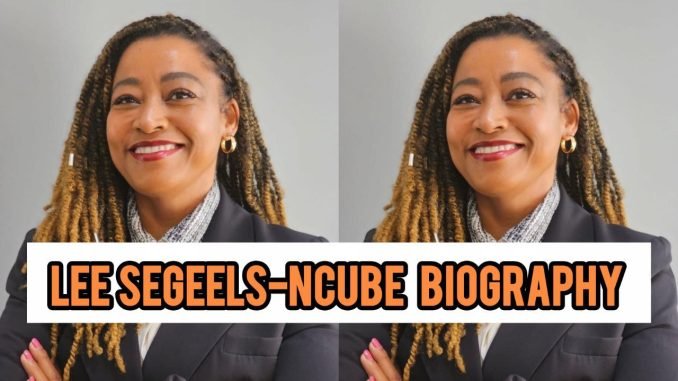
Lee Segeels Ncube Biography
Lee Segeels-Ncube was born on January 2, 1979, in Johannesburg, South Africa. She studied law at the University of Johannesburg (formerly RAU) and was admitted to the Johannesburg Bar in 2013. Since then she has worked from Sandown Chambers in Sandown Village Office Park, a well-known legal hub in Johannesburg. Her professional profile shows a lawyer who focuses on public and commercial law, and who moved quickly from private practice into high-profile public work. Lee Segeels-Ncube is 46 years old as of 2025.
Lee’s route into the Johannesburg Bar followed the usual path for advocates: university training, pupillage or early practice, then formal admission to the Society of Advocates. Over the years she has built a reputation for careful legal research, clear courtroom questioning and a calm manner when cross-examining witnesses. Those qualities helped her move from commercial matters into cases and inquiries that touch on public administration and police oversight. Her chambers list contact details and practice areas, confirming her steady presence at the Bridge Group of Advocates in Sandown Chambers.
Lee Segeels Ncube Career
Lee Segeels-Ncube’s work covers administrative law and commercial law. As an advocate she acts for both public and private clients and appears in courts and tribunals. Her LinkedIn and firm profile note a background that includes work with firms and a rising role at the Johannesburg Bar. In reserve and reported cases she has been visible for asking sharp questions and for organising complex legal arguments, skills that make her effective in matters where law, governance and facts meet.
Her name first appeared in national reporting when she was linked to high-profile matters such as contested Transnet deals and state procurement disputes. In at least one media story she was quoted while challenging aspects of what was described as a questionable commercial arrangement, showing her willingness to probe into deals that raised public concern. That kind of work — where commercial law meets public interest — prepared her for more sensitive roles that require both legal skill and an ability to manage documentary evidence and witness testimony.
At the Bridge Group of Advocates she is one of several Johannesburg-based juniors and advocates who share chambers in Sandown. The Bar environment exposed her to matters ranging from company law to administrative review, and it gave her practical experience leading teams, running evidence and building arguments that can withstand close scrutiny. Colleagues and journalists now cite her not only for careful legal craft but also for steadiness under pressure — a key asset in public inquiries.
Lee Segeels Ncube – Madlanga Commission
Lee Segeels-Ncube became widely known to the public when she was named as an evidence leader at the Madlanga Commission of Inquiry. The commission has a national mandate to probe allegations around policing, political interference, and organised crime links inside state institutions. As an evidence leader, her role is to organise witness testimony, present key pieces of evidence, and question witnesses so that the commission can build a clear factual record. News outlets covering the hearings identify her among the legal figures steering the inquiry.
The Madlanga Commission sits at the centre of heated national debate. It was established to examine claims that involve policing operations, intelligence units, and alleged capture by criminal networks. The hearings have produced testimony that many experts and MPs call “revelatory,” and the commission’s work overlaps with parliamentary oversight processes. Lee’s role as evidence leader places her in the thick of those exchanges: she frames questions, introduces documents, and helps the commission test witness accounts against the available record. Her careful, methodical style has been noted in live reporting of the hearings.
That job is not without risk. Commissions operate where politics, public sentiment and legal standards meet, and evidence leaders must be both rigorous and impartial. Observers have pointed out that the Madlanga Commission’s remit sometimes overlaps with Parliament’s ad hoc inquiries into related matters. Experts say the two processes serve different functions — the commission reports to the president while parliamentary committees exercise the power of legislative oversight — and both have exposed serious issues in policing and the justice system. Lee’s legal skill has been necessary to keep the commission’s work focused on credible evidence and to test complex claims in public.
Her presence in the hearings has also shown how the modern advocate must be comfortable with media scrutiny. High-profile public inquiries generate continual news, social media commentary and political reaction. That context makes evidence leaders’ work visible and sometimes contentious. Still, lawyers like Lee Segeels-Ncube are central to turning conflicting claims into queries that a judicial or quasi-judicial process can examine and, where needed, produce recommendations for reform or accountability.
Conclusion
Lee Segeels-Ncube’s career shows a steady move from skilled junior advocate to a legal professional trusted with sensitive public work. Her grounding in administrative and commercial law, her years at the Johannesburg Bar, and her evident calm in court prepared her for the demanding role of evidence leader at the Madlanga Commission. That commission is tackling some of the most difficult questions facing South Africa’s policing and justice systems, and Lee’s role illustrates how legal practice contributes to public accountability.
FAQs
Who is Lee Segeels-Ncube and where does she practise?
What areas of law does she focus on?
Her main practice areas include administrative law and commercial law, which cover public law challenges, regulatory reviews and commercial disputes.
What is the Madlanga Commission and what role does Lee play?
The Madlanga Commission is a presidential commission of inquiry looking into allegations involving policing and possible criminal infiltration. Lee Segeels-Ncube serves as an evidence leader, helping present and test witness evidence before the commission.
Why is the Madlanga Commission important for South Africa?
The commission is important because it seeks to uncover facts about alleged corruption and capture within policing and related institutions. Its findings may lead to recommendations for accountability and reform and are part of broader parliamentary and public oversight processes.

James George is a journalist and writer who focuses on construction and mining, with 11 years of experience reporting on projects, safety, regulations, and industry trends. He holds a BSc and an MSc in Civil Engineering, giving him the technical background to explain complex issues clearly.
Leave a Reply