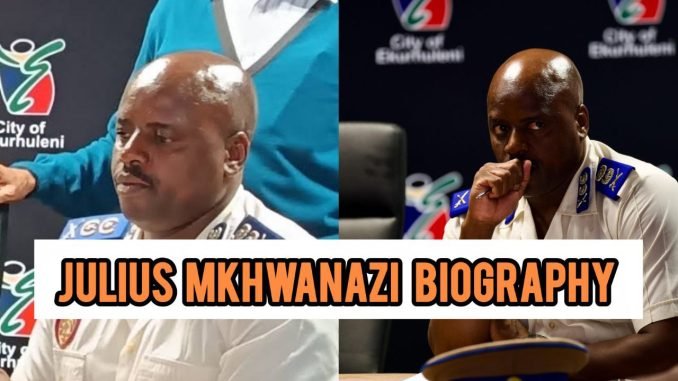
Julius Mkhwanazi Biography
Julius Mkhwanazi was born on February 5, 1973, in KwaZulu-Natal, South Africa. He rose through the ranks of municipal policing to become one of the most senior officers in the Ekurhuleni Metropolitan Police Department (EMPD). Over time his name became well known not only inside the EMPD but also in wider public debates about policing and procurement in the City of Ekurhuleni. His public profile grew further after testimony given at the Madlanga Commission of Inquiry in 2025, which is probing allegations of criminality and political interference across law-enforcement structures. Julius Mkhwanazi is 52 years old as of 2025.
Mkhwanazi carries the rank of brigadier and has served as Deputy Municipal Commissioner for Operations and Specialised Services at the EMPD. In recent years he acted as the head of the department when senior colleagues were on leave or suspended. Those acting roles brought wider responsibility and more public visibility — which in turn made his decisions and relationships the subject of scrutiny. The story that follows shows how internal workplace decisions can have far-reaching consequences when questions of procedure and integrity arise.
Julius Mkhwanazi Career
Julius Mkhwanazi’s background is a mix of operational police work and senior management inside a municipal law-enforcement body. He studied at the University of South Africa and spent much of his career in the EMPD, where he handled operations, specialised units and deployments for major civic events. As a senior officer he took part in planning for city events, in procurement decisions for the EMPD and in managing staff promotions and appointments. Those responsibilities are typical for a deputy head in a big municipal police department, but they also create many points where governance and oversight must be tightly observed.
Within the EMPD, colleagues and municipal officials described Mkhwanazi as someone who could move quickly to fill operational gaps. That capacity can be useful during crises or staffing shortfalls. But when speed replaces formal procedure, mistakes and irregularities can follow. In the testimony that surfaced at Madlanga, a number of appointments and procurement choices that happened under his watch raised questions about process and transparency — issues that investigators and the public now want explained.
Before the most recent controversies, Mkhwanazi’s public record also included engagement with standard policing functions and city security work. He was listed on EMPD pages as a senior operational official and was involved in the department’s day-to-day running. That hands-on experience made him a central figure when questions later arose about how certain contracts and security arrangements were handled.
Julius Mkhwanazi Personal Life
Public records and reports indicates Julius Mkhwanazi is married to Esethu Mkhwanazi and a father of three. He keeps most of his family life out of headlines, and media coverage has focused mainly on his professional role and the legal and ethical questions attached to it. Like many public officials, the spotlight on his career has also drawn attention to his private life, but mainstream reporting has avoided dwelling on family details beyond basic confirmation. That restraint reflects both respect for privacy and an emphasis on matters of public interest — namely, decisions taken in his professional capacity.
Julius Mkhwanazi Allegations and Controversies
The allegations against Julius Mkhwanazi centre on a sequence of decisions and relationships that investigators and a suspended former chief of EMPD say undermined proper process.
At the Madlanga Commission of Inquiry in November 2025, suspended EMPD chief Jabulani Mapiyeye gave testimony accusing Mkhwanazi of making 55 senior promotions and appointments between May and July 2024 without following normal advertising and selection procedures. Mapiyeye told the commission he was not consulted and that some posts were filled out of process while he was still in office. That evidence placed the manner of those appointments under a microscope because fairness and public-service rules require transparent recruitment for senior posts.
Alongside the promotions issue, much of the public concern focuses on Mkhwanazi’s alleged ties to Vusimuzi “Cat” Matlala, a controversial tenderpreneur. Testimony and investigative reporting say Mkhwanazi authorised arrangements that allowed Matlala’s CAT VIP Security company to provide services for municipal events and to use vehicles fitted with blue lights — an ability typically reserved for state law-enforcement vehicles under South African law. Internal probes and a report by the Independent Police Investigative Directorate (IPID) found evidence suggesting improper dealings, and IPID recommended disciplinary action for corruption and fraud. Those findings prompted an official referral to the national director of public prosecutions for a decision on criminal charges.
The allegations do not only implicate Mkhwanazi. Mapiyeye told the commission that actions were taken with the backing or approval of other municipal officials — including the city manager and senior HR and legal staff — and that interference blocked proper disciplinary follow-up. Claims that disciplinary processes were stalled or diverted are especially sensitive because they raise questions about institutional accountability and the ability of oversight bodies to complete their work. Journalists and watchdogs have highlighted how delays in processing IPID recommendations can frustrate both justice and public confidence.
Another troubling detail raised by media and commission testimony is the way memorandums of understanding (MOUs) were presented. Investigators said that spurious MOUs were used as the basis for payments and favours that benefited Matlala’s companies. IPID’s investigators described examples where municipal letters and instructions appeared to be forged or misused to justify services and vehicle licences. If true, those acts would amount to misuse of public resources and a breach of law-enforcement ethics, prompting both disciplinary and criminal scrutiny.
Mkhwanazi’s defenders would likely point out that allegations must be tested in fair processes. Until courts or formal disciplinary hearings reach conclusions, he remains entitled to the presumption of innocence. But the weight of investigative reporting, the IPID findings and the testimony at the Madlanga Commission have placed him at the centre of a broader inquiry into whether criminal networks and patronage have undermined policing functions in Ekurhuleni. That possibility — of criminal capture within a municipal police service — is what has made the story politically and socially explosive.
Officials have responded in various ways. Mkhwanazi was granted special leave as inquiries continued, and EMPD internal processes were activated in response to IPID’s recommendations. The DPP’s eventual decision on prosecution will be a key step in determining whether criminal charges proceed. Meanwhile, the Madlanga Commission continues its work, and public hearings aim to establish facts and propose remedies to restore integrity in policing structures.
Conclusion
As a senior EMPD commander, Julius Mkhwanazi held power to shape operations, staffing and security choices. The allegations against him — irregular promotions, questionable MOUs with private security firms, and misuse of police privileges like blue lights — are serious. They have prompted investigations by IPID, scrutiny at the Madlanga Commission, and public debate about whether policing institutions have been compromised. What happens next will depend on the outcomes of formal disciplinary procedures and any decisions by prosecutors.
FAQs
Who is Julius Mkhwanazi?
Julius Mkhwanazi is a brigadier and senior official at the Ekurhuleni Metropolitan Police Department who has acted in top leadership roles and was named in recent commission testimony and investigative reports.
What are the main allegations against him?
Key allegations include making 55 senior promotions without proper process, entering or authorising suspect MOUs with a private security firm linked to Vusimuzi “Cat” Matlala, and permitting blue-light fittings on private vehicles — matters that IPID investigated and the Madlanga Commission has examined.
Has IPID recommended action?
Yes. The Independent Police Investigative Directorate produced findings that recommended disciplinary steps and referred matters to the national director of public prosecutions for a decision on possible criminal charges.
What did the Madlanga Commission hear about Mkhwanazi?
At the commission suspended EMPD chief Jabulani Mapiyeye testified that Mkhwanazi acted without proper consultation, made multiple irregular appointments, and entered into questionable arrangements with Matlala’s firms — testimony that placed these events under formal inquiry.
What happens next in the inquiry?
Investigations and the Madlanga Commission are ongoing. The DPP will decide whether to prosecute based on IPID’s docket. The commission’s final report may recommend wider reforms in policing and municipal oversight to prevent similar problems in future.

James George is a journalist and writer who focuses on construction and mining, with 11 years of experience reporting on projects, safety, regulations, and industry trends. He holds a BSc and an MSc in Civil Engineering, giving him the technical background to explain complex issues clearly.
Leave a Reply