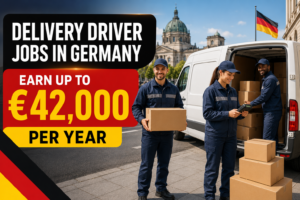
Germany has one of Europe’s largest transport, logistics and e-commerce markets. Online retailers, courier companies, supermarkets, pharmacies, food distributors and logistics businesses depend on drivers to move parcels and goods between warehouses, businesses and customers.
Delivery drivers in Germany can earn approximately €28,000 to €42,000 annually, depending on vehicle type, experience, region, employer, overtime and allowances. However, foreign applicants should understand that ordinary parcel delivery and professional heavy-goods driving are treated differently under Germany’s immigration and licensing rules.
A delivery job does not automatically provide a German work visa. Non-EU applicants need an employment offer and a residence route that legally covers the position.
What Does a Delivery Driver Do?
A delivery driver collects goods from a warehouse or distribution centre and transports them to customers or businesses.
Common responsibilities include:
- Inspecting the delivery vehicle
- Loading goods in the correct order
- Planning an efficient route
- Using navigation and delivery applications
- Delivering parcels or products
- Collecting signatures or electronic confirmation
- Receiving payments where required
- Handling returned goods
- Communicating with customers
- Reporting damaged or missing items
- Maintaining delivery records
- Refuelling or charging the vehicle
- Reporting mechanical problems
- Following road-safety regulations
Some drivers only operate vehicles, while others must also perform considerable lifting, loading and customer-service work.
Types of Delivery Driver Jobs
1. Parcel Delivery Driver
Parcel drivers deliver packages to homes, offices and collection points.
They may work for:
- Courier companies
- E-commerce businesses
- Postal-service contractors
- Local logistics companies
- Online retailers
Parcel drivers may complete many stops during one shift. Speed is important, but drivers must still follow road-safety and working-time rules.
2. Postal Delivery Driver
Postal drivers transport letters and parcels between sorting centres, post offices and delivery locations.
Some postal positions combine driving with walking or cycling deliveries.
3. Food Delivery Driver
Food drivers transport meals from restaurants to customers. Some use:
- Cars
- Motorcycles
- Electric bicycles
- Scooters
Food-delivery work may be performed as employment or through platform-based arrangements. Applicants should confirm whether the position is a genuine employment contract or self-employment.
4. Grocery Delivery Driver
Grocery drivers deliver supermarket purchases and may need to carry products into apartment buildings.
The work often includes:
- Checking orders
- Maintaining refrigerated items
- Collecting crates
- Handling returns
- Communicating with customers
5. Furniture Delivery Driver
Furniture drivers transport large household items. These positions commonly require lifting and may involve assembling products inside customers’ homes.
6. Appliance Delivery Driver
Appliance drivers deliver refrigerators, washing machines, cookers and other equipment. Some positions require basic installation knowledge.
7. Pharmaceutical Delivery Driver
These drivers transport medicine and medical supplies between warehouses, pharmacies, clinics and hospitals.
Punctuality, accurate records and temperature control may be important.
8. Refrigerated Delivery Driver
Refrigerated drivers transport perishable products such as:
- Meat
- Dairy products
- Frozen food
- Fruit and vegetables
- Medicines
They must monitor vehicle temperature and follow food-safety or pharmaceutical-storage procedures.
9. Business-to-Business Driver
Business delivery drivers transport supplies, spare parts or documents between companies.
These positions may offer more predictable schedules than residential parcel delivery.
10. Heavy-Goods Vehicle Driver
Heavy-goods drivers transport larger quantities of goods using vehicles in categories such as C1, C1E, C and CE.
This is a professional-driving occupation with different licensing and qualification requirements from ordinary van delivery.
Germany has special immigration regulations for certain non-EU professional HGV, coach and bus drivers. These rules do not automatically apply to ordinary car or van delivery jobs.
Delivery Driver Salaries
The German Federal Employment Agency reports median gross monthly earnings of approximately €2,692 for delivery drivers. The lower quartile is around €2,314, while the upper quartile is approximately €3,170. Federal Employment Agency salary data
That produces the following approximate annual figures:
| Monthly gross salary | Approximate annual salary |
|---|---|
| €2,300 | €27,600 |
| €2,500 | €30,000 |
| €2,692 | €32,304 |
| €3,000 | €36,000 |
| €3,170 | €38,040 |
| €3,500 | €42,000 |
Professional heavy-vehicle drivers have a reported median salary of approximately €3,196 per month, with the upper quartile around €3,787. Professional-driver salary data
Can Delivery Drivers Earn €42,000?
Yes, but €42,000 should be treated as a possible upper salary rather than a guaranteed starting amount.
A driver is more likely to reach this level through:
- Professional heavy-vehicle driving
- Night or weekend shifts
- Overtime
- Long-distance delivery
- Hazardous-goods responsibilities
- Refrigerated transportation
- Several years of experience
- Supervisory duties
- Employment under a favourable collective agreement
- Work in a higher-paying region
- Performance or attendance bonuses
An annual gross salary of €42,000 equals approximately:
- €3,500 per month
- €808 per week
- €20.19 per hour at 40 hours weekly
The net salary will be lower after tax and social-security deductions.
Gross Salary and Take-Home Pay
German employment advertisements normally state gross salary.
Deductions may include:
- Income tax
- Health insurance
- Pension insurance
- Unemployment insurance
- Long-term care insurance
- Church tax where applicable
The final take-home amount depends on the worker’s tax class, marital status, children, health-insurance arrangement and other personal circumstances.
General Requirements
Requirements vary, but employers may request:
- A valid driving licence
- A safe driving record
- Legal permission to work in Germany
- Basic or intermediate German
- Physical fitness
- Ability to lift packages
- Experience driving commercial vehicles
- Punctuality
- Customer-service skills
- Ability to use navigation applications
- Clean criminal-record documentation
- Willingness to work shifts
- Knowledge of local traffic regulations
Some positions require previous delivery experience, while others provide training.
German-Language Requirements
Ordinary delivery jobs are customer-facing. Drivers must understand addresses, instructions, traffic signs and safety requirements.
Employers may expect German at approximately A2 or B1 level, although requirements differ.
German is especially useful for:
- Speaking with customers
- Contacting dispatchers
- Reporting accidents
- Understanding delivery notes
- Following workplace instructions
- Communicating with police
- Handling complaints
- Reading road signs
Some international logistics companies accept basic English for selected positions, but stronger German generally improves employment opportunities.
Driving-Licence Requirements
Ordinary Cars and Vans
A category B licence normally covers cars and lighter delivery vans within the permitted vehicle weight.
Foreign licences are not treated identically. Whether a person can use or exchange an overseas licence depends on:
- Country of issuance
- Period of German residence
- Licence category
- Applicable recognition agreement
- Whether theoretical or practical tests are required
Applicants should check the rules with the responsible German driving-licence authority.
Heavy Vehicles
Professional HGV drivers generally need an EU or EEA licence in one of the relevant categories:
- C1
- C1E
- C
- CE
They must also hold the required professional driver qualification, commonly associated with the relevant EU initial qualification and Code 95.
Germany’s official skilled-worker portal confirms these requirements for professional drivers. Professional-driver requirements
Ordinary Delivery Driver Versus Professional Driver
| Ordinary delivery driver | Professional HGV driver |
|---|---|
| Usually operates a car or van | Operates a heavy truck |
| Often requires category B | Requires C1, C1E, C or CE |
| Delivers parcels or local goods | Transports larger freight |
| Salary is generally lower | Salary may be higher |
| Special professional-driver visa rules usually do not apply | May qualify under special professional-driver rules |
| Primarily local routes | May involve regional or international routes |
Applicants should not apply for an HGV job using only a standard car licence.
Visa Options for Foreign Applicants
Citizens of the European Union, European Economic Area and Switzerland generally do not need a visa to work in Germany.
Citizens of other countries normally require an appropriate visa or residence permit.
The possible route depends on:
- The exact job
- Whether it is considered qualified employment
- The applicant’s vocational qualification
- Professional experience
- Salary
- Employer
- Driving licence
- Whether a collective agreement applies
Special Route for Professional Drivers
Germany has special employment rules for third-country professional drivers.
These rules can apply to qualified:
- HGV drivers
- Coach drivers
- Bus drivers
The German employer needs approval from the Federal Employment Agency. The driver must ultimately obtain the correct EU or EEA driving licence and professional qualification.
Official guidance states that third-country nationals may be employed as HGV, coach or bus drivers even without formal German vocational training, provided the employment and professional requirements are satisfied. Professional drivers from third countries
This route does not automatically include ordinary parcel drivers using cars or light vans.
Entering Germany for Driver Qualification
In some circumstances, a foreign professional driver who does not yet have the required EU licence or initial qualification may enter Germany to complete the necessary measures.
The employer may initially hire the applicant for alternative duties while the driver completes:
- Licence conversion
- Driving lessons
- Theory examinations
- Practical examinations
- Professional driver qualification
- Language or workplace training
The employment and qualification plan must meet the relevant legal requirements.
Visa for Qualified Professionals
This visa may be possible when an applicant has:
- A recognised vocational or academic qualification
- A concrete job offer
- Qualified employment matching the qualification
- Federal Employment Agency approval where required
- The necessary work and licence requirements
Basic parcel delivery may not always meet the definition of qualified employment. The specific position and vocational requirements must be examined.
Visa for Professionally Experienced Workers
This route is intended for qualified, non-regulated employment and generally requires:
- A recognised foreign vocational or academic qualification
- At least two years of relevant professional experience within the required period
- A concrete qualifying job offer
- The applicable minimum salary or collectively agreed pay
- Federal Employment Agency approval
The official minimum gross salary for this route is €45,630 in 2026, unless the employer is bound by a collective agreement and pays according to it. Visa for professionally experienced workers
Because €42,000 is below the normal €45,630 threshold, an ordinary €42,000 delivery job would not automatically satisfy this visa route. A collective-agreement exception or another residence category would be required.
Opportunity Card
Germany’s Opportunity Card allows eligible people from outside the EU to enter Germany temporarily to search for qualified employment.
It can permit:
- Job searching
- Part-time work totalling up to 20 hours weekly
- Short job trials
- Applications for a suitable residence title after securing qualified employment
However, the Opportunity Card does not guarantee that an ordinary delivery job will qualify for a long-term work residence permit. Official Opportunity Card guidance
Vocational Training Pathway
Germany offers recognised vocational training in transport, courier, express and postal services.
Possible programmes include:
- Professional driver training
- Courier, express and postal services
- Warehouse logistics
- Transport and logistics operations
A foreign applicant with a training contract may apply for a vocational-training visa if all requirements are satisfied.
Vocational training usually combines:
- Paid workplace learning
- Vocational school
- Practical assessments
- Theoretical examinations
German-language ability is important because classroom lessons are normally taught in German.
What Does “Visa Support” Mean?
An employer offering visa support may assist with:
- Providing an employment contract
- Preparing employment documentation
- Communicating with the Federal Employment Agency
- Starting the fast-track procedure
- Supporting licence conversion
- Arranging professional-driver training
- Helping the worker find accommodation
- Providing language courses
- Supporting registration after arrival
Visa support does not guarantee approval. German authorities decide whether the applicant and position meet the legal requirements.
Working Conditions
Delivery work can be physically and mentally demanding.
Drivers may work:
- Early mornings
- Evenings
- Nights
- Weekends
- Public holidays
- Busy holiday seasons
- Different weather conditions
- High-volume delivery routes
They may need to:
- Climb stairs
- Lift heavy packages
- Enter and exit the vehicle repeatedly
- Find difficult addresses
- Work under delivery deadlines
- Handle traffic congestion
- Communicate with dissatisfied customers
Working Hours and Overtime
The contract should clearly state:
- Standard weekly hours
- Daily schedule
- Break periods
- Overtime rate
- Weekend payments
- Night-shift additions
- Holiday entitlement
- Rest days
- On-call requirements
Applicants should be cautious when an attractive annual salary depends on excessive hours.
Employee Benefits
Depending on the employer, drivers may receive:
- Paid annual leave
- Health insurance through the social-security system
- Pension contributions
- Paid sick leave
- Work clothing
- Delivery vehicle
- Mobile device
- Fuel card
- Overtime compensation
- Night-shift allowances
- Holiday bonuses
- Christmas bonus
- Meal allowance
- Professional training
- Licence support
- Relocation assistance
Benefits vary and should be confirmed in writing.
Where to Find Delivery Jobs
Candidates can search through:
- Make it in Germany
- Federal Employment Agency job listings
- EURES
- Official courier-company websites
- Postal-service career portals
- Supermarket career pages
- Logistics-company websites
- Indeed Germany
- StepStone
- Ausbildung portals
Useful German search terms include:
- Auslieferungsfahrer
- Paketzusteller
- Kurierfahrer
- Lieferfahrer
- Fahrer Klasse B
- Berufskraftfahrer
- LKW-Fahrer
- Fahrer Klasse C/CE
- Zusteller
- Servicefahrer
How to Apply
Step 1: Identify the Vehicle Category
Confirm whether the job involves a bicycle, car, van or heavy truck.
Step 2: Check Your Licence
Determine whether your current licence can be used or converted in Germany.
Step 3: Confirm Visa Eligibility
Check whether the position supports an appropriate residence permit. Do not assume that every delivery vacancy qualifies.
Step 4: Prepare a German-Style CV
Include:
- Driving-licence categories
- Years of driving experience
- Vehicle types
- Delivery experience
- Languages
- Safety record
- Logistics skills
- Customer-service experience
- Professional qualifications
- Employment references
Step 5: Apply to Verified Employers
Use official company websites and recognised job portals.
Step 6: Attend the Interview
Employers may ask about:
- Driving history
- Accidents
- Customer service
- Route planning
- Physical fitness
- Shift availability
- Licence conversion
- German-language level
Step 7: Review the Contract
Confirm:
- Gross monthly salary
- Guaranteed hours
- Overtime
- Vehicle type
- Work location
- Contract length
- Probation period
- Paid leave
- Bonuses
- Licence costs
- Accommodation assistance
Step 8: Complete the Visa Process
Submit the required employment, qualification, financial and identity documents to the responsible German authority.
Step 9: Travel After Approval
Do not start work until you hold the appropriate immigration and driving authorisation.
Preparing a Strong CV
Avoid a vague description such as:
Worked as a driver.
Use a specific statement:
Completed an average of 80 residential deliveries daily, maintained digital delivery records and achieved a 98% successful first-attempt delivery rate.
Other useful achievements include:
- Safe kilometres driven
- Number of daily deliveries
- Types of vehicles operated
- Customer-satisfaction ratings
- Accident-free driving history
- Experience with refrigerated goods
- Route-optimisation results
- Forklift or warehouse experience
Recruitment Scam Warning
Be cautious if someone:
- Guarantees a German visa
- Sells a delivery job
- Refuses to name the employer
- Promises a €42,000 salary without a contract
- Claims a car licence allows HGV driving
- Says no work permit is required
- Asks you to enter Germany as a tourist and work
- Requests payment through a personal account
- Provides no official company email
- Promises permanent residence immediately
- Refuses to explain licence conversion
- Claims every parcel-delivery job qualifies for a work visa
Verify the employer through its official website and confirm immigration requirements through German government sources.
Frequently Asked Questions
Can delivery drivers earn €42,000 annually?
Yes. Experienced delivery or professional heavy-vehicle drivers may reach €42,000 through higher base pay, overtime and allowances. The national median for ordinary delivery drivers is lower.
Do I need a university degree?
No. Most driving jobs do not require a university degree. However, a recognised vocational qualification may be important for certain visa routes.
Can an ordinary van driver obtain Germany’s professional-driver visa?
The special professional-driver rules mainly cover HGV, coach and bus drivers with the required licence categories and qualifications. They do not automatically cover light-van parcel delivery.
Can I use my Nigerian driving licence?
Temporary use or exchange conditions depend on German rules and the licence category. You may need translations, examinations and a German or EU licence. For professional heavy vehicles, additional qualifications are required.
Is German compulsory?
The required level depends on the employer and visa route, but German is extremely important for customer communication, safety, road signs and workplace instructions.
Does a job offer guarantee a visa?
No. The immigration authorities must confirm that both the applicant and the employment meet the legal conditions.
Is accommodation provided?
Some employers help workers find accommodation, but free housing is not standard. The employment offer should state any housing arrangement.
Conclusion
Delivery-driver jobs in Germany can provide gross annual earnings of approximately €28,000 to €42,000, depending on the type of vehicle, experience, employer, region and working hours.
Ordinary delivery drivers generally operate cars or vans and earn less than specialised HGV drivers. Germany’s special professional-driver immigration rules mainly apply to qualified truck, coach and bus drivers—not automatically to parcel-delivery workers.
Foreign applicants should confirm licence-conversion requirements, distinguish basic delivery from professional heavy-vehicle driving and verify that the position qualifies for a suitable work visa before paying fees or making travel arrangements.

Leave a Reply